A restful intermission from the busyness of life, a time to eliminate stress by viewing the beautiful, blended colors of one of the most beloved painters to come from the Impressionist movement. Claude Monet is well loved and appreciated by modern viewers and copies of his paintings reflect the hues and emotions that many love to have in their homes.
Enjoy a meandering saunter among the paintings of Claude Monet.
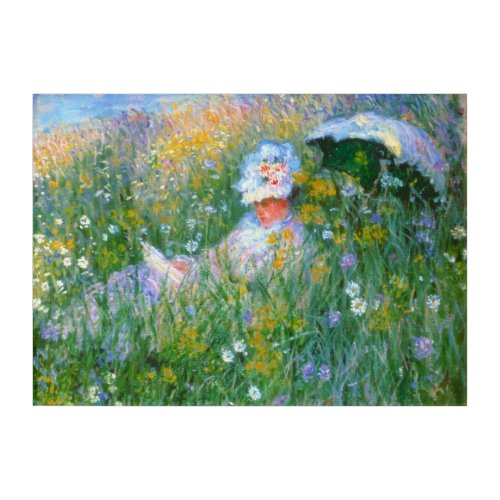
‘Dans La Prairie’ by Claude Monet circa 1879
Respite in the Garden of Giverny
There is something restful, but at the same time alive, from the colors and feeling of a summer’s day in many of these paintings. Perhaps because so many of them were of gardens, flowers, along with the beauty of such sunny blue skies.
And so this lens inspection is dedicated to taking a few moments to stop and peer into the paintings of Claude Monet while listening to background sounds and thinking a bit about his painting and life.
Enjoy yourself here, pour yourself a glass of refreshment or a cup of tea and think light and cheerful thoughts as inspired by the colors and brushstrokes of Impressionism at its most blithe.
Monet’s garden at Vétheuil,
The Allure Of His Art
The Inspiration for the Monet Moment
I wanted to take a tour of this Master’s paintings because I think they produce a serenity in the viewer. A moment’s respite while looking at his paintings produces a visual calming, similar to the way some sounds and music de-stress us.
For me, I think it is partially in his palette, the way this painter layered his colors, partly in the technique of the brushstrokes that create the dreamy effect, and partly because of the subject matter that the overall feeling is one of quiet and repose. Of course, I have my favorites, but almost any of his works have a peaceful appeal.
Claude Monet’s ” Lady with a Parasol”
If I would pick my own personal favorites they would center within the water garden. I like the water lily paintings especially, perhaps for the same reason I like macro floral photographs. The larger than life look into the forms of the petals creates an almost abstract arrangement. The blues and greens predominate, and it is well known that those cool hues are restful and calming in effect.
It isn’t that I don’t like sharp edges or bright colors, I do! However, in a jarring modern age when the mind is overwhelmed with so much stimulation, I find it necessary to tone things down and relax with these soothing paintings. I put this lens view together in the hope that it has that effect for you, my visitor, too.
A Garden Is Art!
Nowhere is that more evident than in this place in Giverny, So much of the masterstrokes were rooted inside this particular place, although there are certainly many other venues that Claude Monet made famous with his works. In celebration of his garden I have taken a look at the flowers that made up the subject matter of the garden at Giverny.
For anyone who loves cottage gardens, this famous artist/gardener’s plans will be a priceless inspiration.
“Gardening was something I learned in my youth. I perhaps owe having become a painter to flowers” – Claude Monet
Flowers of Giverny, Flowers that Monet Grew Monet’s Giverny is one of the most famous cottage gardens filled with scenes created by the Master. Here are his flowers, so you can make your own masterpiece garden.
Passion – Coffee Table Book for those with a passion
A gorgeous art book for those who love gardens and love Monet. Lasting inspirations from photos alive with the beautiful colors and design genius of a master- both on canvas and in the garden.
Why He Planted His Famous Garden
“Monet started to create his flower-filled garden when he moved to Giverny in 1883, refining it over 43 years. He originally planted flowers so that he could pick bunches to have something to paint indoors on rainy days.”-The Guardian
The Much Painted Water Garden
The water garden, and the famous blue-green Japanese style bridge are among the most famous scenes in the artist’s garden. He painted them numerous times and they are among the most loved of his scenes. The colors are always restful and dreamy.
There are many other colors that appear in his paintings of his gardens, of course, and Monet planted his garden specifically for certain harmonies and to provide inspiration for his art.
The Japanese Bridge Over His Famous Waterlily Pond
En Plein Air
means “in the open air”. Outdoor painting was favored by French Impressionist painters.
Seasonal borders in one of the world’s famous gardens. This is a book to pore over in winter and create spring and summer plans for your own flower color combinations.
Dreams of Color Made Visible On Canvas
The dreamy quality of a painting
One of the reasons we find for Monet’s venerable popularity rests in the dreamy and restful feeling he gives his paintings, but with such inner movement so that the viewer is never bored. Much like the beautiful quality of dreams, both those of a daydream on a summer day or the dreamlike state of a drowsy evening.
Many famous artists suffered from eyesight problems, Monet’s were well-known. By analyzing the depictions of the scenes and the tints of the colors, modern scientists can diagnose some of the issues of his poor eyesight and how that affected the way he painted.
During his lifetime it was known he suffered from cataracts.
As cataracts develop details fade out and shapes blur, white yellows, greens become yellow-green and reds are perceived as oranges. Blues and purples become replaced by reds and yellows.
Monet, for whose work fine variations in color were a hallmark, often expressed his frustration to friends and family as his vision failed between 1912 and 1922.
“He wrote letters to friends, how colors were getting dull, and it was hard to tell them apart, and how he had to label tubes of paint,” Marmor said. “He was very vocal about how his failing eyesight was affecting him.”
An example of how the artists failing eye sight changed the tonal effects of his paintings.
Giverny
When the artist was at his height creatively and where his happiness fairly saturates his canvases.
Monet felt Venice was a city “too beautiful to be painted”
Dreamlike Color
His fuzzy view of the world gives his paintings the dreamlike quality and results in a calming melange of color for the viewer.
As for the the opinion of the researcher into the results of this sight loss:
“I think it does not say that the paintings are good or bad or answer to the question as to how much they were trying to change their style,” Marmor said. “But I think it points out very dramatically some physical limitations that they had, which both limited their ability to paint, to put paint on canvas directly, but also to interpret what they were putting on a canvas-they couldn’t really judge what they were seeing.”
If you are in love with Monet’s Garden, yet another source for inspiration and reflection on his plantings and paintings
‘Giverny Garden’ c.1890 Philip Leslie Hale – American Impressionist Painter – 1865 – 1931
Summer, Giverny’ 1910 Clark was an American Painter – 1876 – 1949
He was an artist who inspired his generation and those following it to look at nature a whole new way, paint in “plein air”, and, unwittingly perhaps, turn a handicap like poor eyesight into an artistic asset.
Morning on the Seine, Near Giverny, 1896
These Colors In Your Home
Monet’s Colors In Your Home
Taking interior decor colors from one of your favorite paintings is like the reverse of finding paintings to match the room. With many of the color picker apps available, this is a cinch to accomplish.
One of my favorite sites for creating a color board from favorite pictures is Colourlovers.com.
From creating some color boards, whether online or off, the design for a room’s color coordination is a step away. A very important component of your interiors is completed.
Waterlily Paintings
Water Lilies of the Orangerie as Giverny
Morning on the Seine near Giverny
I believe one of my favorites is “Morning On The Seine”, perhaps because of the way the picture is divided between the blues and greens in a way that almost looks like fractals or the way a kaleidoscope breaks colors.
The Boat at Giverny (Or) the Norwegians, the Three Daughters of Mme. Hoschede
Home Decor Color Schemes
The Palette
At the beginning of his career Monet used dark colors, but from 1860 on, Monet shunned dark colors and worked from a palette of pure and pale hues.
If you look carefully, what appears black is almost never really black. It might be purple or a mix of colors, but not ivory black.
He said of this:
“As for the colors I use, what’s so interesting about that ? I don’t think one could paint better or more brightly with another palette. The most important thing is to know how to use the colors. Their choice is a matter of habit. In short, I use white lead, cadmium yellow, vermilion, madder, cobalt blue, chrome green. That’s all.”
Traditional American Holidays Through Grandma Moses Eyes
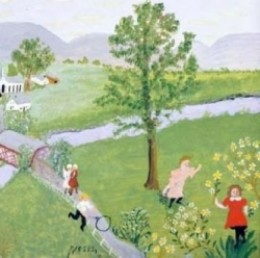
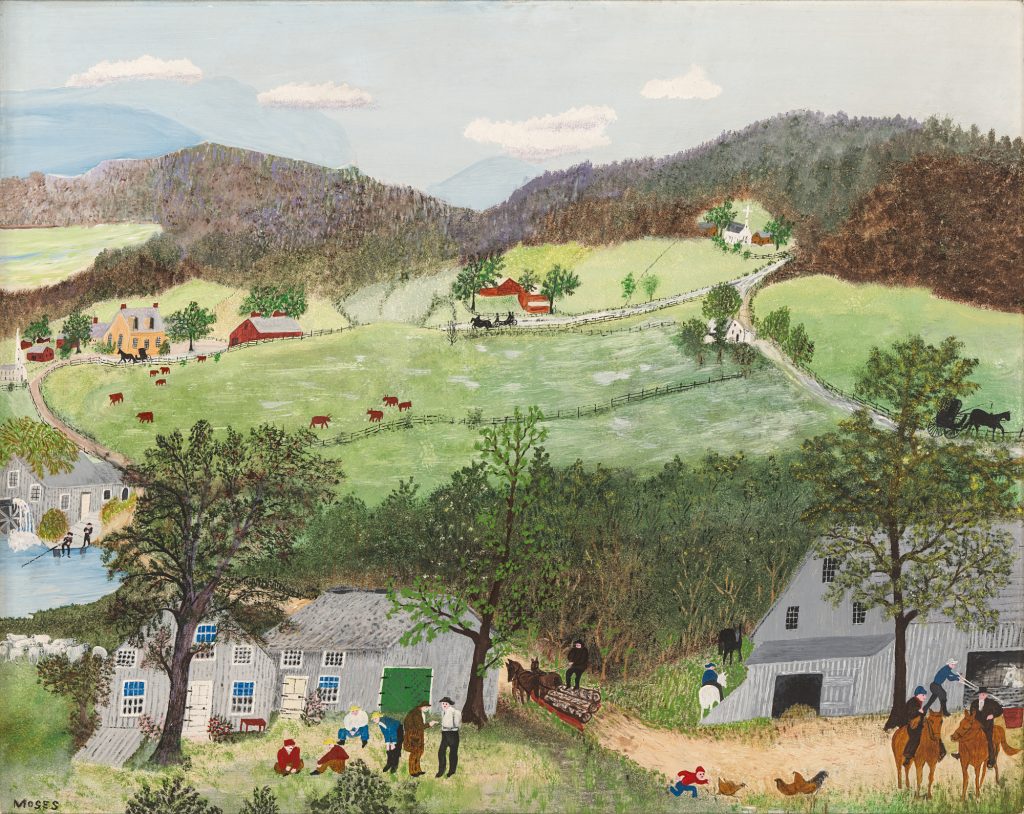
Spring
One of the things that endeared Grandma Moses, as Anna Mary Robertson Moses was known, was her ebullient painting of tasks and times that were important to the hearts of Americans. She masterfully brushed her naïve paintings in an almost childlike way, but filled with pictured memories of the many years of a lifetime of living.
She painted scenes that in her time were no longer a part of the daily existence of most Americans, but that harked back to their distant memories of their own “Grandmas”.
The simple, but hardworking lives of the former generations were evoked in that dreamy and softened way that the years between so generously gave them. In return, modern day people were reassured of the soundness of their roots and the cultural DNA they came from.
Grandma Moses is an artist ideally suited to accompany us as we travel through some of our favorite celebrations of the year, and celebrate her art, at the same time.
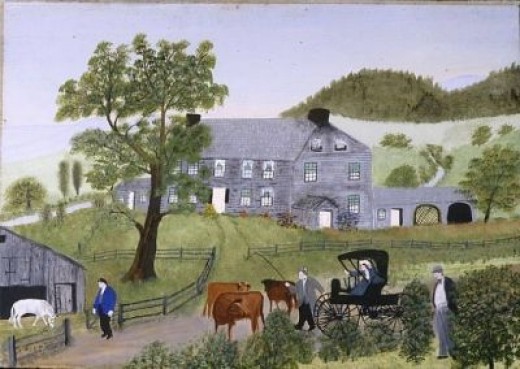
Grandma Moses recalls a buggy ride
‘Good Fun’ – By Grandma Moses
‘Good Fun’, painted in 1957, is one of her famous winter scenes with colorfully bundled group riding a horse pulled sledge full of cut evergreens for Christmas. She was probably most famous for her winter fun paintings. Whether it was Thanksgiving “catching turkeys” or sledding down snow covered hills, there were many opportunities to use the backdrop of winter.
Illustrating some of the many ways country folk made use of their time while waiting for spring planting to arrive depicted in may of these art pieces.
Winter was brightened by the holidays of Thanksgiving and Christmas, and capped off with the festivities of Maple Sugar time.
“Sugaring Off” 1942
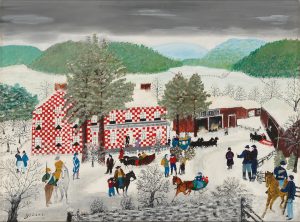
Checkered House, 1955
Rural Simplicity in Autumn – sometimes a season is the celebration
Sometimes holidays aren’t official, and in America, especially, we love to celebrate important local events. Maybe that is passed down from our forebears. The community times of quilting bees and barn raisings were all looked forward to and took place in their own seasonal times of year.
Grandma Moses helped record the celebrations of holidays from the self sufficient tasks of the farming culture she was a part of, and recorded how many Americans took advantage of times to get together and have fun while they worked.
Times of Fellowship and Community
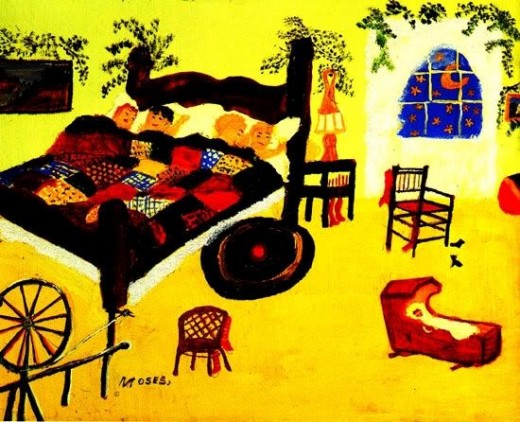
Quilting Bee
Gathering for quilting bees
Quilting Bee
1950
Grandma Moses painted the special holiday times we all take part in within our collective calendar throughout the year. Included were those event special to early Americans: the quilting bees, sugaring off, and making apple butter.
While most of her works are remembrances of work activities like Maple Sugaring, working around the farm, sewing quilts, etc, a number are of rest and celebrations.
America of her time observed Christian Sabbath, resting during Sundays. It was a common practice, when worked stopped for the day. This, too, was a holiday from work each week.
Grandma Moses, We Are Resting, 1951
OBSERVATIONS ABOUT GRANDMA MOSES
“As a hard-working, elderly widow who advocated traditional American values like industry and self-sufficiency, and whose appearance and mannerisms bespoke of a bygone era, Moses perfectly embodied an idealized representation of the archetypal “benign great grandmother,” -J.E. Barnes
The County Fair
County fairs were a time to show off canned goods, garden produce, and livestock. It was a brief holiday during the growing season for those in Agricultural pursuits.
Originally, this was a Church holiday:
” … In the eighth century Pope Gregory II moved the church festival of All Saints to November 1. The move-in part offered a substitute for the popular pagan celebration of the Celtic New Year, which honored both the Sun god and Samhain, Lord of the Dead. The Celts believed at the New Year the dead came back to mingle among the living. As the ghosts thronged about the houses of the living, they were greeted with tables loaded with food. After feasting, masked and costumed villagers, representing the souls of the dead, paraded to the outskirts of the town leading the ghosts away. Horses, sacred to the Sun god, were often sacrificed, and there are some records of human sacrifice during the festival.
… Even into the eleventh century, many pagan beliefs were accepted by Christians-beliefs such as the fear of Fate, the use of medicinal herbs with incantations, sacrifices at springs and crossroads to the spirits of the place
… .In the tenth century, Abbot Odilo of Cluny began celebrating the November 2nd following “All Saints’ Day” as “All Souls’ Day” to honor not just the martyrs, but all Christians who had died. People prayed for the dead, and many other superstitions continued. Food was offered to the dead, and it was often believed that on these two festivals souls in purgatory would take the form of witches, toads or demons and haunt people who wronged them during their lifetimes.” – Christian History Institute article,2007
The American Interpretation
From History.com,
“In the late 1800s, there was a move in America to mold Halloween into a holiday more about community and neighborly get-togethers, than about ghosts, pranks, and witchcraft.
At the turn of the century, Halloween parties for both children and adults became the most common way to celebrate the day. Parties focused on games, foods of the season, and festive costumes. “
That is largely the way it is celebrated now, perhaps with less of the sense of fun, and more morbidly centered on the darker and more frightening side of the holiday.
In this scene, Grandma Moses shows the night alive with activity. The trick or treaters dressed up in sheets and the jack o’lanterns, along with the traditional holiday colors of orange and black recall Halloween for the painter and the viewer.
Grandma Moses’ Halloween
A very American holiday.
Halloween
1955
What is Halloween?
In America, it is the time to dress up in costumes and on “Beggar’s Night” parade through the neighborhood, visiting houses on the block for free goodies, especially favorite candies and candy bars. Many people hold parties on Halloween, and decorate their homes and businesses with appropriately scary decorations.
Pumpkins play a big part in decorating and celebrating Halloween. Carving out faces and making the pumpkin into a lantern is a favorite activity. Anything “spooky” becomes part of the event.
The Year with Grandma Moses A book that focuses on a year in Grandma Moses’ world, to delight anyone with scenes from all seasons. Great way to encourage your own budding artists.
Grandma Moses Quote
“I paint from the top down. From the sky, then the mountains, then the hills, then the houses, then the cattle, and then the people. “
Over The River…and Through the Woods – to Grandmother’s House We Go!
Over The River to Grandma’s House, from an old Thanksgiving song.
Over the River To Grandma’s
‘Over The River To Grandma’
1945
The song, that means “Thanksgiving holiday” to many, is recalled by this painting in its title. My own grandmother remembered the bells on the horses as they drew a sleigh through the snow, and this is the picture that is conjured up for us. Not just the sleighs, but frozen creeks and the fun that was a part of what could be very hard winters buried deep in snow.
A Boy’s Thanksgiving Day
A Boy’s Thanksgiving Day (lyrics)
Over the River and Through the Woods
Over the river and through the woods, To grandmother’s house we go;
The horse knows the way To carry the sleigh, Through the white and drifted snow, oh! Over the river and through the wood, Oh, how the wind does blow! It stings the toes, And bites the nose, As over the ground we go.
Over the river and through the woods, To have a first-rate play; Oh, hear the bell ring, “Ting-a-ling-ling!” Hurrah for Thanksgiving Day-ay!
Over the river and through the woods, Trot fast my dapple gray! Spring over the ground, Like a hunting hound! For this is Thanksgiving Day.
Over the river and through the woods, And straight through the barnyard gate. We seem to go extremely slow It is so hard to wait!
Over the river and through the woods, Now Grandmother’s cap I spy! Hurrah for the fun! Is the pudding done? Hurrah for the pumpkin pie!
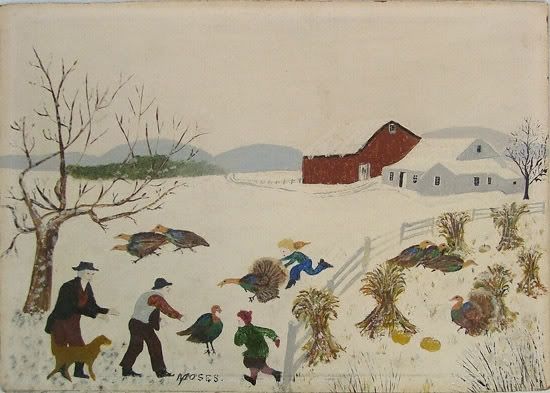
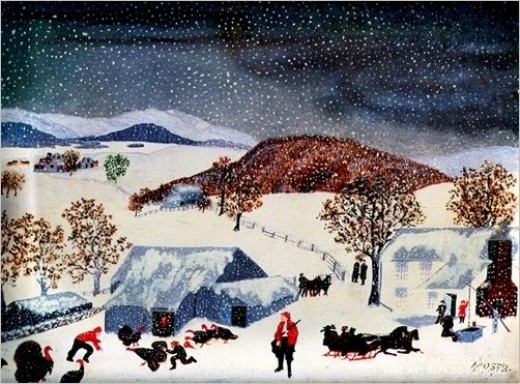
Catching Your Own Turkey
Food for The Table – Catching The Turkey
Catching the Thanksgiving Turkey
1943
Catching your own turkey for the Thanksgiving feast is a truly an event of the past for the vast majority of us, but the traditional feast of roast turkey with all the trimming is essentially intact.
In Grandma Moses time, as in today’s holiday, Thanksgiving was a time for families of America to meet together while remembering the Puritans, the debt to the Indians, and generally give thanks to God for the bounty of the harvest that year. It is a time to reflect on one’s many blessings while getting as stuffed as the centerpiece of the meal, the Roast Turkey.
Another scene of “Catching the Turkey”
Thanksgiving – Catching the Thanksgiving Turkey
One her favorite subjects
Catching the Turkey
Because “Catching The Turkey” was one of her favorite themes, there are a number of variations on it. It is obvious that snowy scenes were one of those that she liked, there are so many of them. I love the wide range of seasons, and have a hard time choosing between them.
This artwork of Grandma Moses is not so well known as the others. It portrays the fantasy of Santa Claus, his sleigh, and reindeer flying up into the sky.
A favorite tale of many during the Christmas Eve rituals of leaving cookies for Santa, perhaps reading the “T’was the night before Christmas” poem… and awaiting the big event, Christmas! Twas The Night Before Christmas
Christmas Eve Tradition – puzzles
At my house we like to have a puzzle to put together on Christmas Eve. Here is one with a Grandma Moses picture. Service Is Over 250 Piece Wooden Jigsaw Puzzle Part of the fun is the puzzle and part is the pretty picture at the end. This has both pieces of the fun.
I love the details and the large amounts of color that gives just enough challenge for a Christmas Eve session of putting together the puzzle.
Christmas and Christmas Eve – Waiting for Christmas
Surely one of the most beloved of holidays, Christmas in America has followed quite a journey to come to its present form. Our celebration history ranges from the earliest Puritans (who did not observe it at all) to the exuberant Victorians who created many of the traditions we now know as an integral part of Christmas.
For many, Christmas is filled with cut evergreens, shiny lights and decorations, sweets galore and festive social events.
For me, one of those people who loves Christmas, there is far too much to say on the topic within this tribute to Grandma Moses. Consequently, you might wish to look at my Christmas pages about traditional ways to celebrate. Christmas Traditions In a nutshell, it is the holiday in which we celebrate the nativity of Jesus, “Jesus is the reason for the season”, as they say. It included the type of family closeness and joy that Grandma painted into her depictions of this holiday.
Waiting for Christmas
Waiting for Christmas “Waiting for Christmas”
1960
Notice the expressions on the children’s faces as they await Christmas morning. The excitement of putting off sleep delays the dreams of sugar plums to the very last possible moment.
Christmas
Holiday Celebration
Christmas celebration caps the year with family gathering together to open presents, enjoy the decorations and engage in a holiday feast.
No matter which American holiday is your favorite, it seems that Grandma Moses painted a dear, old fashioned memory to match it.
I hope you enjoyed this sampling of her charming work which helped open the way for many other folk paintings to be appreciated.
My family also uses Amazon Prime often, which saves us money on shipping and more.
Please support my site by using my links, thank you. This Page may contain affiliate links. “As an Amazon Associate I earn from qualifying purchases”




 His fuzzy view of the world gives his paintings the dreamlike quality and results in a calming melange of color for the viewer.


 She was probably most famous for her winter fun paintings. Whether it was Thanksgiving “catching turkeys” or sledding down snow covered hills, there were many opportunities to use the backdrop of winter.
Illustrating some of the many ways country folk made use of their time while waiting for spring planting to arrive depicted in may of these art pieces.
Winter was brightened by the holidays of Thanksgiving and
She was probably most famous for her winter fun paintings. Whether it was Thanksgiving “catching turkeys” or sledding down snow covered hills, there were many opportunities to use the backdrop of winter.
Illustrating some of the many ways country folk made use of their time while waiting for spring planting to arrive depicted in may of these art pieces.
Winter was brightened by the holidays of Thanksgiving and 

 Sometimes holidays aren’t official, and in America, especially, we love to celebrate important local events. Maybe that is passed down from our forebears. The community times of quilting bees and barn raisings were all looked forward to and took place in their own seasonal times of year.
Grandma Moses helped record the celebrations of holidays from the self sufficient tasks of the farming culture she was a part of, and recorded how many Americans took advantage of times to get together and have fun while they worked.
Sometimes holidays aren’t official, and in America, especially, we love to celebrate important local events. Maybe that is passed down from our forebears. The community times of quilting bees and barn raisings were all looked forward to and took place in their own seasonal times of year.
Grandma Moses helped record the celebrations of holidays from the self sufficient tasks of the farming culture she was a part of, and recorded how many Americans took advantage of times to get together and have fun while they worked.



 Let Me Help!